 Top Trending
A Jar That Tries to Put the Mediterranean Diet Into One Softgel and Two Capsules. The Diet Has Thirty Years of Data. The Only Randomized Trial of It Came Out Even. Chapter by Chapter, What the Jar Can and Cannot Copy.
RELEVATE is a supplement from NeuroReserve, a company in Las Vegas, built, its maker says, to fill seventeen nutritional gaps between what most Americans eat and what people on a Mediterranean or MIND diet get from fish, greens, berries, olive oil and tea: one softgel and two capsules a day, with food, thirty days to the jar. I read the diet studies the jar leans on, then the trials of each nutrient inside it, then the shipping and refund pages, and wrote it down in chapters.

This is a paid advertisement. Sponsored by NeuroReserve Inc.

Harold Wexler is the pen name of this desk.
This page quotes no customers: the seller's site shows a count and an average for its reviews, and the tools I use could read the count but not the words, so I quote none rather than guess.
Everything about the jar, from the seventeen lines on the panel to the refund policy, comes from the seller's own label and pages, read on September 9, 2026.
I'm in the later chapters, as they say, and I read about diets the way I read about the weather: with interest, and without much intention of changing.
So when a supplement arrived on my desk that claims to put the Mediterranean diet in a jar, I understood the appeal at once.
Eat the fish, the greens, the berries and the olive oil, the studies say.
Or, says the jar, swallow three things with lunch and skip the fish.
That's a fair thing to want, and it deserves a fair answer, which is longer than the label.
Here's the short version, and I'll spend the rest of the page earning it.
The diet the jar copies has thirty years of observational data behind it, and one randomized trial.
The observational data is good.
The randomized trial, the only one, came out even.
And the nutrients in the jar, taken one at a time in their own trials, mostly did nothing for the memory of healthy people over 65.
A jar built to copy a diet inherits the diet's evidence, and the diet's evidence is an association, not a proof. Then each nutrient in the jar has to answer for itself, and most of them can't.
Here's what the jar is.
A white plastic jar from NeuroReserve, a company in Las Vegas, Nevada, holding thirty softgels and sixty capsules mixed together.
A day is one softgel of fish-roe oil and two capsules of vitamins, minerals, plant pigments and plant extracts: seventeen lines on the panel, or sixteen, depending on how you count a blend.
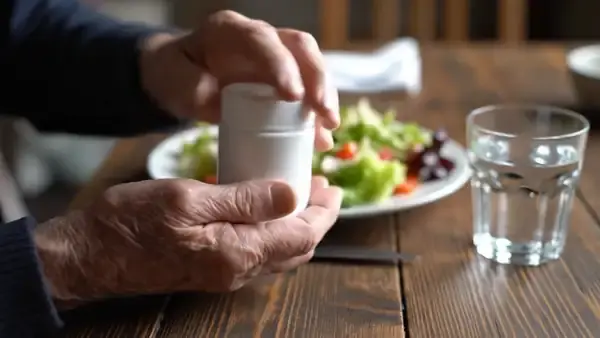
Taken with food.
Thirty days to the jar.
Made in a facility the seller says is certified by NSF.
I did what I always do.
I read the label before the listing.
I read the two diet studies the jar leans on, the observational one and the trial.
I read the trials behind each nutrient, at the doses they actually used.
And I read the shipping and refund pages, which are generous, and the reviews page, which I'll be honest about.
What I found is a carefully assembled jar, honestly labeled, that copies the shopping list of a good diet at a fraction of the amounts, from a company that ships at no charge and refunds the first jar; and that the studies say the plate did the work, not the list.
One more thing before the first chapter, because most of you got here from one of our own advertisements.
Those ads talk about a boxed cereal, three foods, three drinks, and three words or phrases a man is supposed to be able to say or spell.
None of that is in the jar, and I won't pretend it is.
It's on this page, in its place: the cereal, the drinks and the word test are chapter twelve, and the honest version of every headline we run is in the guide linked at the foot.
Chapter one · The jarNinety Pieces, Seventeen Lines, and a Shopping List Turned Into a Panel
This is what's on the table.
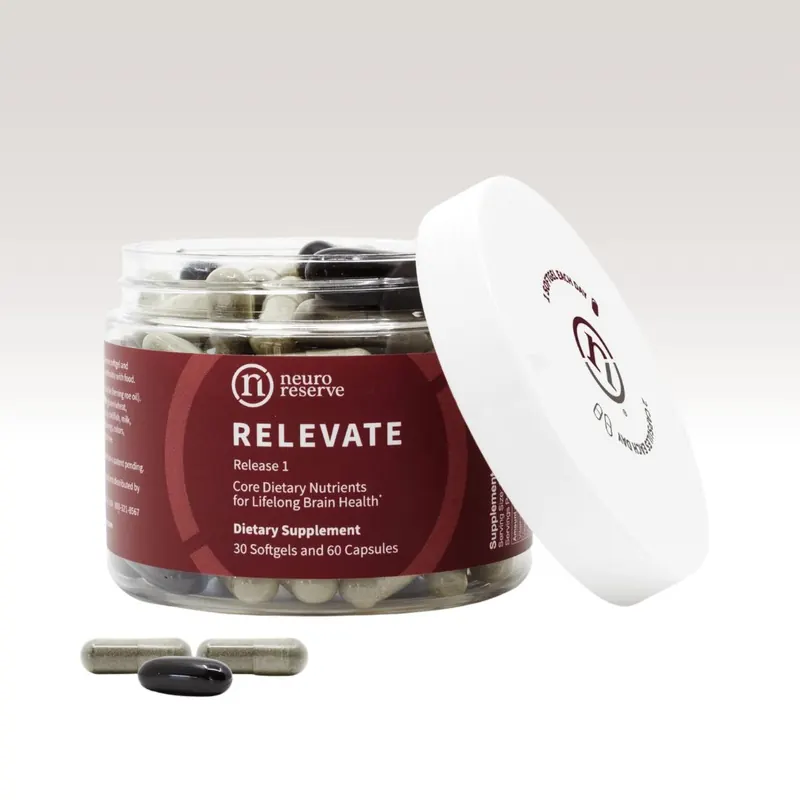
A white jar with a blue-green label.
The softgels and capsules are mixed in the same jar, on purpose; the seller's own questions page says customers preferred one jar to three.
The front says a supplement for brain health and longevity, with the asterisk every supplement in America carries.
The panel, per day, reads like a shopping list turned into milligrams.
Vitamin D3, 30 micrograms.
Vitamin E, 20 milligrams, with 40 more of a cousin called gamma-tocopherol.
Niacin, 50 milligrams.
Vitamin B12, 20 micrograms.
Magnesium, 50 milligrams.
A phospholipid and omega-3 complex from herring roe, 645 milligrams, of which DHA 200 and EPA 58.
Lutein, 5 milligrams, and zeaxanthin, 1.
A 280-milligram blend of four plant flavonoids: anthocyanins from bilberry, quercetin, kaempferol and myricetin.
Green tea catechins, decaffeinated, 200 milligrams.
L-theanine, 50 milligrams.
And pterostilbene, 25 micrograms.
Then the softgel, which is gelatin, and the capsule, which is plant fiber.
The directions are one line: "Take one softgel and two capsules daily, preferably with food."
The cautions are the usual ones: pregnancy, any health condition, other supplements or daily medicine, ask first.
Two things to hold onto from the panel.
There's fish in it, herring roe, so it isn't for a fish allergy, and gelatin, so it isn't vegetarian.
And that last line, 25 micrograms of pterostilbene, is a number I'll come back to, because micrograms are not milligrams.
Chapter two · The diet it copiesNine Hundred Sixty Older Adults, Five Years, and Seven and a Half Years of Age
Let me start with the study the jar is built on, because it's a good one, and I want you to see it before I take anything away from it.
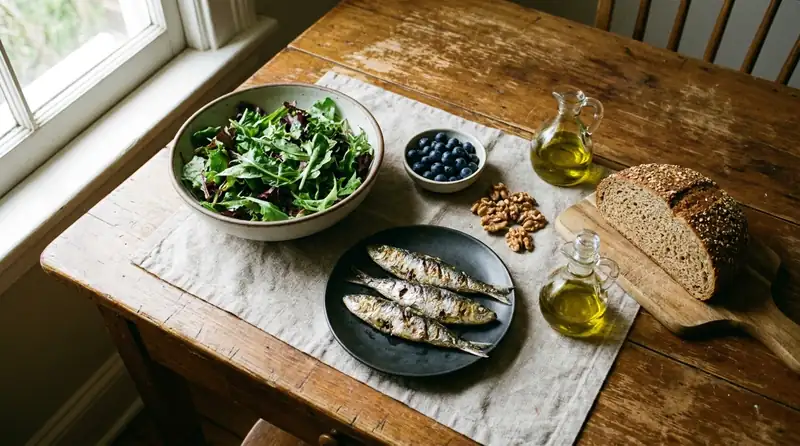
The MIND diet is a hybrid of the Mediterranean diet and the diet clinicians give people to lower circulation readings, tilted toward the foods that had turned up again and again in memory studies: leafy greens, berries, nuts, whole grains, beans, fish, poultry, olive oil.
It was built at a Chicago medical center, and the first study of it followed 960 older adults for an average of 4.7 years, scoring how closely their meals matched the pattern.
The ones in the top third held their thinking scores better than the bottom third, and the gap worked out to about seven and a half years of age. [1]
That's the finding the jar is sold on, and it's real. Read the shape of it: people who already ate that way, followed over years, did better than people who didn't.
It's an association.
The people who eat greens and fish also tend to walk more, drink less, sleep better and have more money.
The study did what it could to account for that, and the finding held.
But a finding like that is a reason to run a trial, not a proof.
So someone ran the trial.
Chapter three · The trial that came out evenSix Hundred Four People, Three Years, and No Difference
This is the chapter the jar's label doesn't mention, and the one I'd want you to read twice.
In 2023 the same research group published the only randomized trial of the MIND diet.
Six hundred four older adults with normal cognition, all overweight and eating poorly, were assigned to follow the MIND diet or a control diet, both with mild calorie restriction and both with counseling, for three years.
Both groups improved their global cognition scores over the three years.
The MIND group by 0.205 standardized units, the control group by 0.170.
The difference between them, 0.035, was not significant.
Brain scans in a subset were similar in both groups. [2]
The best diet trial anyone has run found that three years of the MIND diet did no better than three years of a plain diet with the same counseling and the same change on the scale.
Both groups got better.
The pattern didn't matter; the attention did.
That doesn't make the diet bad.
Eating greens and fish is still the right thing to do for a dozen reasons.
But it does mean a jar that copies the diet's shopping list is copying something that, in its one fair test, came out even.
Everything below the fold is a nutrient answering for itself.

Chapter four · The fishHerring Roe, 200 Milligrams of DHA, and the Trials That Found Nothing
The biggest line on the panel, and the one with the most trials behind it.
The jar's fish is herring roe oil, 645 milligrams of a phospholipid and omega-3 complex, of which 200 milligrams is DHA and 58 is EPA.
That's about a quarter of a gram of the two long omega-3 fats.
A serving of sardines gives you several times that.
Now the trials, which are the clearest on this page.
A 2012 Cochrane review pooled the randomized trials of omega-3 supplements in cognitively healthy people over 60: three trials, cognitive scores for 3,536 people.
After 24 or 40 months, no difference from placebo on a mental-status score, or on word learning, digit span or verbal fluency. [3]
An Australian trial gave 390 healthy adults aged 65 to 90 a full 2.3 grams a day of DHA-rich fish oil for 18 months, nine times this jar's DHA.
It didn't maintain or improve cognitive performance, and one speed measure went slightly the wrong way. [4]
A Swiss trial gave 2,157 adults over 70 a gram a day for three years.
No effect on a cognitive screening score. [5]
Two gentler findings, with their small print.
A 2015 pooled analysis found DHA, alone or with EPA, improved episodic memory in adults who already had mild memory complaints, and that above a gram a day it helped regardless. [6]
A two-year Irish trial of 60 adults over 65 combined a gram of fish oil with carotenoids and vitamin E, and found fewer working-memory errors, a small effect I can't pull apart. [7]
The trials that found nothing used four to nine times this jar's DHA.
The analysis that found something started above a gram a day.
The jar holds a quarter of a gram of DHA and EPA together.
The fish line is the most-tested thing in the jar, and the tests say: at doses far above this one, nothing for the memory of a healthy man over 65.
Eat the sardines anyway.
They're cheaper.
Chapter five · The greensLutein and Zeaxanthin, at Half the Dose That Worked
Two lines for the leafy greens, and the pair with the best small trials.

Lutein and zeaxanthin are the yellow pigments in kale, spinach and egg yolk.
They collect in the eye and turn up in brain tissue, and the jar takes them from marigold, as most supplements do.
Five milligrams of lutein and one of zeaxanthin: six together.
The two one-year trials in older adults both used twelve.
Sixty-two adults, average age 74, twelve milligrams a day for a year: better complex attention and mental flexibility than placebo, in the 51 who finished. [8]
Forty-four adults, average age 72, twelve milligrams for a year: the pigments appeared to buffer slide on a word-pair task, and the scans changed. [9]
Twelve milligrams a day, for a year, in people in their seventies, is what the trials used. The jar holds six.
A cup of cooked kale carries more lutein than the jar does.
That's not a criticism of the jar.
It's the argument for the plate.
Chapter six · The berriesA 280-Milligram Blend of Four Pigments, and a Blueberry Trial It Can't Be Compared To
The "berries" line, which is really four plant compounds in one blend.
Anthocyanins are the purple in bilberries and blueberries.
Quercetin is in onions and apples.
Kaempferol is in kale.
Myricetin is in berries and a vine tea.
The jar puts 280 milligrams of the four together, and doesn't say how much is each.
The trial to compare it to is a blueberry trial, and it's small.
Twenty-six healthy older adults, average age 68, drank a daily blueberry concentrate carrying 387 milligrams of anthocyanidins for twelve weeks.
Their brain scans showed more blood flow and more activation in some regions, and a working-memory test improved by a hair, right at the edge of significance. [10]
Three hundred eighty-seven milligrams of anthocyanidins from actual blueberries, in 26 people, moved a scan and barely moved a test. The jar holds an unstated share of a 280-milligram blend.
I can't put the berry line beside its trial, because the label won't tell me the number. A bowl of blueberries will.

Chapter seven · The teaTwo Hundred Milligrams of Decaffeinated Catechins
The tea line, and the one study I could put next to it.
Catechins are the polyphenols of green tea, and the jar uses 200 milligrams of a decaffeinated extract, so there's no caffeine in the jar at all.
Fifty milligrams of L-theanine, the tea amino acid, sit beside it.
Japanese adults aged 50 to 69 who felt their memory slipping took 336 milligrams of decaffeinated green tea catechins or a placebo.
After a single dose, they made fewer errors on a continuous-performance test.
After twelve weeks of daily doses, they were faster on a two-back working-memory task. [11]
The abstract I read didn't say how many people took part, so I hold it loosely.
Theanine has a single-dose trial in adults aged 50 to 69 that found a small improvement on an attention task. [12]
Three hundred thirty-six milligrams of catechins in the tea trial.
The jar holds 200.
A cup of green tea holds a good share of that, with the caffeine.
Chapter eight · The vitaminsD, E, Niacin, B12 and Magnesium, With the Trials That Came Out Empty
Five lines of vitamins and one mineral, and the least glamorous chapter.
Vitamin D3, 30 micrograms, a generous dose.
In the Swiss trial above, 2,000 international units of vitamin D a day for three years, alone or with omega-3s and exercise, did nothing for a cognitive screening score in 2,157 healthy adults over 70. [5]
Vitamin B12, 20 micrograms, and niacin, 50 milligrams.
A 2018 Cochrane review of 14 trials in 27,882 cognitively healthy adults concluded that B-vitamin supplements, alone or combined, had no effect on cognition in people who weren't deficient. [13]
If your B12 is low, and it's common after 60 because absorption falls, that's a blood test and a clinician.
Vitamin E, 20 milligrams, with 40 of gamma-tocopherol.
In the Women's Health Study, 6,377 healthy women over 65 took 600 units of vitamin E on alternate days for years, and their cognition didn't differ from placebo. [14]
Twenty milligrams is a fraction of that.
Magnesium, 50 milligrams, about 12 percent of a day's worth. A small handful of almonds.
Three trials with 36,000 people between them, at doses above the jar's, and none of them moved a memory score in people who weren't deficient. The jar's vitamins are for a man with a gap on his blood test, and the blood test comes first.
Chapter nine · Twenty-five microgramsThe Smallest Number on the Panel
The last line, and the one I promised to come back to.
Pterostilbene, 25 micrograms.
Micrograms.
A milligram is a thousand of them.
Pterostilbene is a cousin of resveratrol from blueberries and a tree's heartwood; the human studies I saw used tens of milligrams for other purposes, and I found no trial of it on memory in healthy adults.
Twenty-five micrograms is a thousandth of the smaller doses studied.
It's on the label so the label can list it.
I'd rather tell you that than let a long panel look longer than it is.
Count the lines that answer for themselves at their own dose, in people your age, and you get to none. Count the lines that copy a good plate at a fraction of the plate, and you get the whole jar.
Chapter ten · The reviews I couldn't readTwenty-Four Reviews, an Average of 4.96, and Not One Quoted
The seller's page shows 24 customer reviews with an average of 4.96 stars: 23 five-star and one four-star.
The tools I use could read that count and that average from the seller's review system, but not the words of a single review, and I don't quote what I haven't read.
So this page has no customer quotes, and I'd rather have an empty chapter than an invented one.
If you want them, they're on the seller's product page, under the reviews tab, and you can read all 24 in ten minutes.
Twenty-four reviews for a jar that costs what this one costs is a small number, and a near-perfect average from a small number tells you less than a mixed average from a large one. That's the honest reading, and it's all I have.
Chapter eleven · The likelier explanationWhat Three Pieces With Lunch Actually Do
Suppose you buy it, take the three with lunch tomorrow, and by the end of the month feel a little steadier.
I'd believe you.
And I'd give you three reasons before I gave the jar one.
You sat down to lunch, at a table, with food, because the label says with food.
You did one deliberate thing at the same time every day, which is what a habit is for.
And you thought about the Mediterranean plate every time you opened the jar, which is more than most men do, and some of that thinking leaks into the shopping cart.
There's no caffeine in this one and no stimulant. Whatever you feel by the end of the month, it isn't that.
What actually helps, and costs nothing, is duller than seventeen lines.
- Fish on the plate twice a week. A tin of sardines carries more DHA than a month of the jar's softgels.
- A handful of greens at lunch and dinner. That's the lutein line, at twice the jar's dose, for the price of a bag of kale.
- Berries in the morning instead of the frosted cereal. The blueberry trial used real berries.
- No coffee after two. The three o'clock cup answers three o'clock and wrecks eleven.
- A notebook by the plate. Writing a thing down is the oldest memory aid there is, and it never runs out.
Now look at that list and be honest.
You've heard every item since your first physical, and you still don't do them.
Boring loses to a white jar every time.
If a jar gets you to sit down to lunch with fish and greens on the plate because the jar reminded you of them, it did its work before any softgel did. And the softgel, at this dose, isn't going to do much.

Chapter twelve · The bowl and the cupThe Cereal, the Three Drinks, the Three Foods and the Word Test From Our Own Advertisements
Our advertisements have been saying, in one version or another, that a boxed cereal, three foods and three drinks have something to do with memory, and that there are three words or phrases a man ought to be able to say.
You're owed the honest version, in one chapter, so here it is.
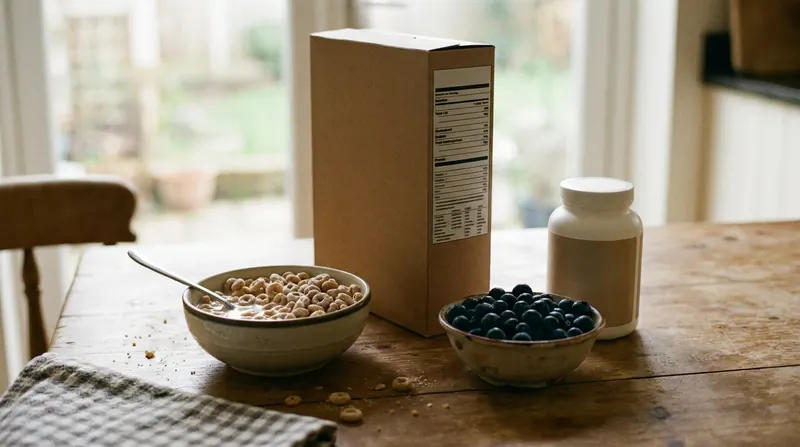
Start with the bowl.
A frosted, honey-coated or chocolate cereal is mostly refined starch and added sugar, and a serving can carry more sugar than a cookie.
No cereal "ages the brain faster than time."
Nobody has measured any such thing, and that phrase was written to be clicked.
What the studies do say is duller, and worth more.
In the Framingham Heart Study, adults who drank more sugary beverages scored lower on tests of memory, and daily fruit juice went the same way. [15]
In a Brazilian study of 10,775 adults followed for eight years, the ones who ate the most ultra-processed food, and the sweet cereal shelf is part of that, lost ground on tests of thinking about a quarter faster than the ones who ate the least. [16]
Both are associations across a population, not a sentence on your bowl.
And a quarter faster than slow is still slow.
The three drinks.
The "evening drink" in our advertisement is alcohol, and it's the one with the strongest case behind it: in 550 British civil servants followed for thirty years, the more a person drank, the faster their scores fell on a word-fluency test, and light drinkers had no edge over those who didn't drink at all. [17]
The second is sugar in a glass: soda, sweetened tea, the tall flavored coffee from the counter, which is a soft drink with coffee in it.
The Framingham finding above is about sugary drinks, and those are sugary drinks. [15]
The third, in one of our headlines, was coffee.
That was our worst headline.
Plain black coffee and plain tea aren't the drinks any of those studies were about.
Keep your coffee.
Keep it before two.
Green tea is on the MIND list, and the jar's tea line is a decaffeinated copy of it.
The three foods.
Processed meat, fried food, and the white-flour shelf: pastries, packaged cakes, white bread.
Our advertisement says "just stop eating these three."
The research says something slower.
In 960 older adults followed for nearly five years, the ones whose meals looked most like the MIND pattern, vegetables, berries, nuts, whole grains, beans, fish and olive oil, held their thinking scores better, and the gap between the top and bottom thirds worked out to about seven and a half years of age. [1]
That's a pattern over years, not a list of three, and it can't be sold in a headline.
Which is exactly why our headline doesn't say it.
It's also the study this jar is built on, and in its one randomized trial the pattern came out even with a plain diet. [2] Chapter three has the whole of it.
Less sugar in the bowl and the glass.
Less alcohol in the evening.
Keep the coffee.
Eat more like the Mediterranean shelf and less like the vending machine.
Every one of those costs nothing, and the jar is a copy of the last one at a fraction of the plate.
The three words, or the three phrases.
There's no such list.
What our advertisement borrowed from is the short, scored mental-status test clinicians have given at the bedside since the 1970s: the date and the place, a few words to hold in mind and give back a minute later, a sum, naming, repeating one sentence, copying a drawing.
It's given in person and read against your age and your schooling by someone trained to do it, and a low score is a reason for a proper look, not a verdict.
Stumbling on a word when you're tired or being timed means nothing on its own.
Nothing begins at a word.
If the worry behind the click is real, that's fifteen minutes with your own clinician, and it costs you nothing from me.
And the advertisement about the things some men take every day.
That one sits closest to real research, and it's the one an advertisement has no business acting on.
Some kinds of daily medicine, including a few sold over the counter for allergies and for the night, are on the lists pharmacists check for people over 65.
Don't stop or change any of it because of an advertisement, ours included. Put everything you take in one bag, this jar included, take it to the pharmacist, and ask one question: is anything here a poor choice at my age?
The jar's vitamin D, its vitamin E and its fish oil are all worth a mention if you take anything daily.
The guide at the foot of this page has that section written out, with the studies.
So if you clicked on the cereal, here's where the cereal went: onto the same table as the blueberries, where the real answer was always the plate the jar is trying to copy.
Chapter thirteen · What it isn'tSix Things a Softgel and Two Capsules Won't Do
- It won't be the diet. The diet's only randomized trial came out even, and the jar copies the diet's shopping list at a fraction of the plate.
- It won't give you the fish. Two hundred milligrams of DHA a day is a quarter of the gram the analysis with a signal started at, and a tenth of the Australian trial that found nothing.
- It won't give you the greens at the trial dose. Six milligrams of lutein and zeaxanthin against the twelve that worked.
- It won't tell you how much berry is in the berry line. The label gives one number for four compounds.
- It won't act on any condition a clinician has named. It's a dietary supplement, and its own label carries the sentence that says so.
- It won't be for a fish allergy or for a vegetarian. Herring roe and gelatin, on the label.
If that list annoys you, I'd rather you were annoyed now than when the box arrives from Nevada.
Chapter fourteen · The routineIf You Do Buy It: One Jar, Thirty Days, One Plate, One Notebook
If you're going to spend the money, spend it as a test with a date on it, and test the thing that can actually work.

- Buy one jar. Thirty days is the test, and the seller's refund covers the first jar for thirty days after it arrives.
- One softgel and two capsules with lunch, at the table, every day. The label says with food; make the food the point.
- Fish twice a week and greens every day anyway. The jar isn't a reason to skip them; it's a copy of them.
- Write one line a day in a notebook. Not "sharper" or "foggier." What you ate at lunch, and what you were doing at four.
- Keep everything else the same for the first two weeks, so the notebook is about the jar. Add the sardines in the third and fourth, so you know what the plate does.
- On day thirty, read the thirty lines. If the second half reads better than the first, decide whether it was the jar or the plate. The notebook will tell you more than the jar will.
Look at that list the way I do.
Four of the six things cost nothing.
The jar is the one you'll pay for, and the plate and the notebook are the ones that will do the work.
Chapter fifteen · Who it's forWho It Suits, and Who It Doesn't
This is worth a look if:
- You know the Mediterranean plate is the right idea and you've now read exactly how the jar copies it, and at what fraction.
- You want every milligram printed, a company with a street address and a toll-at no charge number, shipping at no charge and a full refund on the first jar. You have all four now.
- You can hold two ideas at once: a good diet's evidence, and a jar that inherits only its shopping list.
- You'll run it as a thirty-day test with a notebook and a plate, not as a hope.
- You're not allergic to fish and you don't mind gelatin.
Give it a miss if:
- You want the trial doses of fish oil or lutein. Buy the sardines and the kale, or a product that prints them at the trial amounts.
- You're allergic to fish, or you're vegetarian.
- You want something that acts on a condition a clinician has named. This is a dietary supplement.
- You take anything daily, including a blood thinner, and haven't asked a pharmacist about fish oil, vitamin E and vitamin D. Ask first.
- You want customer reviews you can read on this page. I couldn't read them, so there are none here.
Chapter sixteen · Where it's soldFrom Las Vegas, Shipped at No Charge Within the United States, With a Full Refund on the First Jar
The jar is sold by NeuroReserve on its own website, and that's the only place this page links to.

The company is easy to find.
NeuroReserve Inc., with its office at a village center address in Las Vegas, Nevada, a toll-at no charge number and an email on the contact page.
Its questions page says the jar is made in a facility certified by NSF, an independent auditor, under the FDA's manufacturing rules.
The current price is shown on its page, not here.
The day I read it, a jar cost about what a month of good fish costs, and the subscription price was lower for those who want it.
Buy one jar.
Thirty days is a test.
A subscription to something you haven't tried is a bet.
Now the two things that matter more than the price.
First, shipping.
NeuroReserve ships at no charge within the United States by standard post, three to seven business days, longer at the holidays.
Expedited shipping costs extra.
International orders are by email only.
Second, the refund policy.
Read this twice.
"You may request a full refund up to 30 days after receiving your first order," the seller's page says, by email.
A first order, thirty days from the day it arrives, and the word is full.
It's the most generous line on this page, and for a jar at this price it's the line that makes a thirty-day test possible.
I'd rather say so than bury it.
Everything in a day
| Ingredient | Amount per serving |
|---|---|
| Vitamin D3 (cholecalciferol) | 30 mcg (1,200 IU) |
| Vitamin E (RRR d-alpha-tocopherol) | 20 mg |
| Niacin (nicotinamide) | 50 mg |
| Vitamin B12 (hydroxocobalamin) | 20 mcg |
| Magnesium (bisglycinate chelate) | 50 mg |
| Phospholipid / omega-3 complex (herring roe oil) | 645 mg |
| Lutein and zeaxanthin (from marigold flower) | 5 mg + 1 mg |
| FLAVOCORE® (anthocyanins from bilberry, quercetin, kaempferol, myricetin) | 280 mg |
| Green tea catechins (decaffeinated Camellia sinensis leaf extract, 80 %) | 200 mg |
| L-theanine | 50 mg |
| Pterostilbene (Pterocarpus marsupium wood extract) | 25 mcg |
| Other ingredients: softgel shell (gelatin, glycerin, purified water), vegetable capsule (hypromellose), L-leucine | — |
Full details on each ingredient are in the guide linked at the bottom of this page.
The ingredient and advertising guide linked at the foot of this page goes through every one of the seventeen lines.
What each nutrient is.
What the research does and doesn't show, at what dose.
What to be careful about, fish oil and vitamin D first.
And which of our own headlines it does and doesn't support.
Print it and take it to the pharmacist if you take anything daily.
It's written for that.
See the current price on the seller's site
One softgel and two capsules a day, built around the nutrients that people who eat a Mediterranean or MIND diet get from fish, greens, berries and olive oil.
CHECK AVAILABILITYSold by NeuroReserve Inc. of Las Vegas and shipped at no charge within the United States by standard post · Full refund on a first order, requested within 30 days of receiving it
QuestionsWhat Readers Ask Me Before Their First Jar
Questions readers ask
Is this medicine?
No. It's a dietary supplement, one softgel and two capsules of vitamins, minerals, fish-roe oil and plant extracts, made for a company in Nevada.
The label carries the standard sentence every American supplement carries, the one that says the FDA hasn't evaluated its claims.
Is it really the Mediterranean diet in a jar?
It's the diet's shopping list turned into a panel, at a fraction of the plate: a quarter of a gram of DHA and EPA where a serving of sardines gives several times that, six milligrams of lutein where a cup of kale gives more. The diet's own randomized trial, three years long, came out even with a plain diet.
Chapter three has it.
Does it have caffeine?
No. The tea extract is decaffeinated.
Whatever you feel, it isn't a stimulant.
How much fish oil is in it?
Six hundred forty-five milligrams of a herring-roe complex, of which 200 milligrams of DHA and 58 of EPA. The trials that found nothing in healthy adults over 65 used four to nine times that; the analysis that found something in people with memory complaints started above a gram a day.
Will it help my memory?
I can't tell you that, and you should be wary of any page that does. The diet it copies has good observational data and one even trial.
Each nutrient in the jar, tested on its own at doses above the jar's, mostly did nothing for the memory of healthy people over 65. What the jar can do is remind you of the plate every day at lunch.
Can I take it alongside what I already take?
Ask your clinician or pharmacist and take the ingredient guide with you. Fish oil is worth a mention if you take anything that thins the blood; vitamin D and vitamin E are worth a mention if you already take them; and it contains fish and gelatin.
Two minutes at the pharmacy counter answers all of that.
Why are there no customer reviews on this page?
Because I couldn't read them. The seller's review system gave my tools the count, 24, and the average, 4.96, but not the words.
I don't quote what I haven't read. They're on the seller's page under the reviews tab.
Does it ship to me?
At no charge within the United States, by standard post, in three to seven business days. Expedited costs extra.
Outside the US, by email only.
What if it arrives and I don't like it?
Email the seller within 30 days of receiving your first order and ask for a full refund. That's the policy in its own words, and it applies to the first jar.
Your advertisement was about a cereal, or three foods, or three drinks. Where is that on this page?
In chapter twelve, in full, with the studies. The short version: less sugar in the bowl and the glass, less alcohol in the evening, keep your plain coffee, and eat more like the Mediterranean shelf, which is the plate this jar copies.
None of it is in the jar, and the ingredient and advertising guide at the foot goes through every headline we run and says which ones overstate.
Your advertisement said something about three phrases, or spelling three words. Is there a test I can take?
Not on a screen. The words and phrases come from the short mental-status test clinicians give in person, and it's read against your age and schooling by someone trained to do it.
Nothing begins at a word. If the worry behind the click is real, ask your clinician for the proper test.
It's fifteen minutes.
The short versionEverything Above, in Sixty Seconds
- A white jar of 30 softgels and 60 capsules from NeuroReserve Inc. of Las Vegas: vitamins D, E, niacin and B12, magnesium, herring-roe omega-3s, lutein and zeaxanthin, a four-flavonoid blend, decaffeinated green tea catechins, theanine and 25 micrograms of pterostilbene.
- One softgel and two capsules a day with food. Thirty days to the jar. Contains fish and gelatin. No caffeine.
- The diet it copies: 960 older adults followed for nearly five years, the top third of MIND eaters ahead by about seven and a half years of age. [1] The diet's only randomized trial: 604 people, three years, no difference from a plain diet. [2]
- The fish: 200 milligrams of DHA where the empty trials used four to nine times that. [3] [4] [5] The greens: 6 milligrams of lutein and zeaxanthin where the one-year trials used 12. [8] [9] The vitamins: Cochrane and the Swiss trial found nothing in people who weren't deficient. [13] [5]
- Twenty-four reviews, average 4.96, none quoted here because I couldn't read them.
- Ships at no charge within the US; a full refund on the first jar within 30 days of receiving it.
- The cereal, three drinks, three foods and the word test from our own advertisements, in chapter twelve: less sugar, less alcohol, keep the coffee, more like the Mediterranean shelf, and no test on a screen. None of it is in the jar.
- The honest use: three pieces with lunch as a daily reminder of the plate, a notebook, and thirty days to decide.

The last chapterWhat a Day of the Jar Is Actually Worth
Here's the whole thing in one breath.
Seventeen real nutrients, honestly labeled, from a company that ships at no charge and refunds the first jar.
A diet behind it with good observational data and one fair trial that came out even.
Fish, greens, berries, tea and vitamins, each at a fraction of the plate and mostly below the doses that were tried and found empty.
And 24 customers I couldn't read.
If you're a man who knows the Mediterranean plate is right and wants a daily reminder of it that costs less than a bad habit, that's worth a thirty-day test.
Not because of what's in the jar.
Because of what it puts on the plate beside it.
Buy one jar, not a subscription, put a tin of sardines next to it, and write one line a day for thirty days. The notebook is a better judge than I am.
Check the current price and availability
One softgel and two capsules a day, built around the nutrients that people who eat a Mediterranean or MIND diet get from fish, greens, berries and olive oil.
CHECK AVAILABILITYSold by NeuroReserve Inc. of Las Vegas and shipped at no charge within the United States by standard post · Full refund on a first order, requested within 30 days of receiving it
P.S. If you take one thing from this page, take the two numbers.
Seven and a half years of age between the top and bottom thirds of MIND eaters in the observational study.
No difference at all between the MIND diet and a plain one in its only randomized trial.
Everything about this jar sits between those two lines.
P.P.S. If the afternoon fog has been with you for a year, and it's there in the morning too, talk to your own clinician before you buy anything.
Three pieces with lunch is a small habit.
It was never going to answer a question a clinician answers in fifteen minutes.
P.P.P.S. And if you do order it, keep the notebook and buy the sardines.
When the jar is empty, you'll have thirty lines about your own lunches, and that's worth more than the jar, whichever way the lines turn out.